SplitREC: Using DeepFM Algorithm in SecretFlow#
The following codes are demos only. It’s NOT for production due to system security concerns, please DO NOT use it directly in production.
[1]:
%load_ext autoreload
%autoreload 2
SecretFlow framework provides SLModel to meet user’s needs for Vertical Federated Learning. In the vertical scenario, all parties achieve the purpose of training a better model through complementary features and joint training. In actual application scenarios, the recommendation scenario fits well with the vertical federation solution. It has great application prospects. Different data holders have different features and are unwilling to share with each other, but the features are complementary, such as consumer features, financial features and user portraits, etc. However, recommendation algorithms are often not so directly applicable to split learning. For example, the FM algorithm requires feature crossover. Therefore, we provide a special item in SecretFlow, by encapsulating commonly used recommendation algorithms, to facilitate users to use federated learning for recommendation applications. This article will introduce how to use the DeepFM algorithm in SecretFlow.
Introduction to the principle of DeepFM splitting#
The DeepFM algorithm combines the strengths of FM and neural networks, can improve low-dimensional and high-dimensional features at the same time. Compared with the Wide&Deep model, DeepFM algorithm also eliminates the feature engineering part.
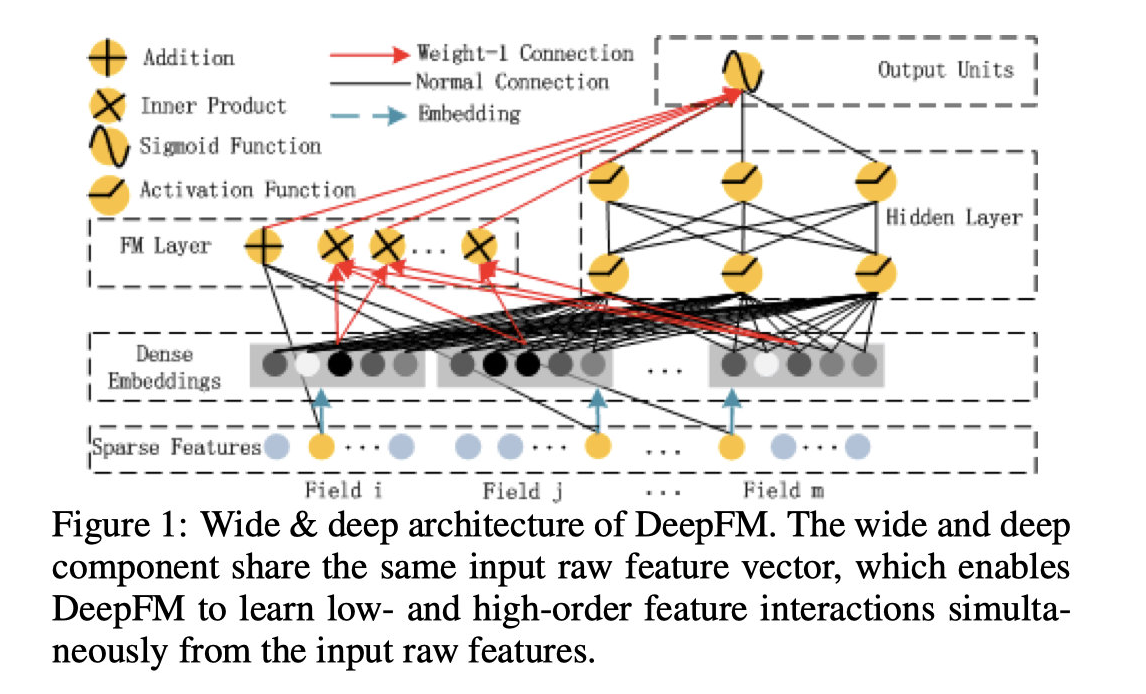
From the overall structure, This model can be divided into two parts, namely the FM part and the Deep part. The input of these two parts is the same, and there is no distinction like the Wide & Deep model. The Deep part is used to train the high-dimensional correlations of these features, while the FM model calculates the two-dimensional cross information between features through the hidden vector v.
DeepFM On SecretFlow#
Split Scheme
DeepFM formula derivation
Mathematical simplification
end up with the formula
DeepFM split version#
It can be seen from the derivation of the above formula that \(V_j\) is eliminated in the calculation of FM
So the problem turns to as long as each party calculates their own \(\sum_{i}^kViX\) and \(\sum_{i}^kV_i^2X^2\), continue to simplify this formula to get
\[\hat{y}=w_0+\sum_{i=1}^nw_ix_i +\frac{1}{2}[\sum_{f=1}^k(\sum_{i=1}^nV_{i,f}x_i)^2 - \sum_{f=1}^k\sum_{i=1}^nV_{i,f}^2{x_i}^2]\]
It can be seen from the derivation of the formula that each participant only needs to calculate the first order \(\sum_{i=1}^aV_{i,f}x_i\) and \(\sum_{i=1}^aV_{i,f}^2{x_i}^2\) locally, and then transmit the two parts (1) and (2) to fusenet to complete the lossless fm part calculation
batchsize*Na*k, and the dimension of Bob is batchsize*Nb*kbatchsize*1, which will not leak the information of the v matrixbatchsize*K, the information on the feature dimension has been eliminated, and only the sum information on the FM vector dimension is retained (usually dim=4)
SecretFlow encapsulation#
DeepFMBase and DeepFMFuse two modules.class DeepFMbase(tf.keras.Model):
def __init__(
self,
dnn_units_size,
dnn_activation="relu",
preprocess_layer=None,
fm_embedding_dim=16,
**kwargs,
):
"""Split learning version of DeepFM
Args:
dnn_units_size: list,list of positive integer or empty list, the layer number and units in each layer of DNN
dnn_activation: activation function of dnn part
preprocess_layer: The preprocessed layer a keras model, output a dict of preprocessed data
fm_embedding_dim: fm embedding dim, default to be 16
DeepFMFuse
class DeepFMfuse(tf.keras.Model):
    def __init__(self, dnn_units_size, dnn_activation="relu", **kwargs):
Let’s take an example to see how to use DeepFM packaged in SecretFlow for training and prediction
Environment settings#
[2]:
import secretflow as sf

# Check the version of your SecretFlow
print('The version of SecretFlow: {}'.format(sf.__version__))

# In case you have a running secretflow runtime already.
sf.shutdown()
sf.init(['alice', 'bob', 'charlie'], address="local", log_to_driver=False)
alice, bob, charlie = sf.PYU('alice'), sf.PYU('bob'), sf.PYU('charlie')
The version of SecretFlow: 1.0.0a0
2023-07-25 11:26:15,683 INFO worker.py:1538 -- Started a local Ray instance.
Dataset introduction#
For details about DataBuilder, please see CustomDataLoaderOnSL
Download and process data#
Data splitting
[3]:
%%capture
%%!
wget https://secretflow-data.oss-accelerate.aliyuncs.com/datasets/movielens/ml-1m.zip
unzip ./ml-1m.zip
[4]:
# Read the data in dat format and convert it into a dictionary
def load_data(filename, columns):
    data = {}
    with open(filename, "r", encoding="unicode_escape") as f:
        for line in f:
            ls = line.strip("\n").split("::")
            data[ls[0]] = dict(zip(columns[1:], ls[1:]))
    return data
[5]:
fed_csv = {alice: "alice_ml1m.csv", bob: "bob_ml1m.csv"}
csv_writer_container = {alice: open(fed_csv[alice], "w"), bob: open(fed_csv[bob], "w")}
part_columns = {
    alice: ["UserID", "Gender", "Age", "Occupation", "Zip-code"],
    bob: ["MovieID", "Rating", "Title", "Genres", "Timestamp"],
}
[6]:
for device, writer in csv_writer_container.items():
    writer.write("ID," + ",".join(part_columns[device]) + "\n")
[7]:
f = open("ml-1m/ratings.dat", "r", encoding="unicode_escape")

users_data = load_data(
    "./ml-1m/users.dat",
    columns=["UserID", "Gender", "Age", "Occupation", "Zip-code"],
)
movies_data = load_data("./ml-1m/movies.dat", columns=["MovieID", "Title", "Genres"])
ratings_columns = ["UserID", "MovieID", "Rating", "Timestamp"]

rating_data = load_data("./ml-1m/ratings.dat", columns=ratings_columns)


def _parse_example(feature, columns, index):
    if "Title" in feature.keys():
        feature["Title"] = feature["Title"].replace(",", "_")
    if "Genres" in feature.keys():
        feature["Genres"] = feature["Genres"].replace("|", " ")
    values = []
    values.append(str(index))
    for c in columns:
        values.append(feature[c])
    return ",".join(values)


index = 0
num_sample = 1000
for line in f:
    ls = line.strip().split("::")
    rating = dict(zip(ratings_columns, ls))
    rating.update(users_data.get(ls[0]))
    rating.update(movies_data.get(ls[1]))
    for device, columns in part_columns.items():
        parse_f = _parse_example(rating, columns, index)
        csv_writer_container[device].write(parse_f + "\n")
    index += 1
    if num_sample > 0 and index >= num_sample:
        break
for w in csv_writer_container.values():
    w.close()
So far we have completed the data processing and splitting#
Produced
alice: alice_ml1m.csv
bob: bob_ml1m.csv
[8]:
! head alice_ml1m.csv
ID,UserID,Gender,Age,Occupation,Zip-code
0,1,F,1,10,48067
1,1,F,1,10,48067
2,1,F,1,10,48067
3,1,F,1,10,48067
4,1,F,1,10,48067
5,1,F,1,10,48067
6,1,F,1,10,48067
7,1,F,1,10,48067
8,1,F,1,10,48067
[9]:
! head bob_ml1m.csv
ID,MovieID,Rating,Title,Genres,Timestamp
0,1193,5,One Flew Over the Cuckoo's Nest (1975),Drama,978300760
1,661,3,James and the Giant Peach (1996),Animation Children's Musical,978302109
2,914,3,My Fair Lady (1964),Musical Romance,978301968
3,3408,4,Erin Brockovich (2000),Drama,978300275
4,2355,5,Bug's Life_ A (1998),Animation Children's Comedy,978824291
5,1197,3,Princess Bride_ The (1987),Action Adventure Comedy Romance,978302268
6,1287,5,Ben-Hur (1959),Action Adventure Drama,978302039
7,2804,5,Christmas Story_ A (1983),Comedy Drama,978300719
8,594,4,Snow White and the Seven Dwarfs (1937),Animation Children's Musical,978302268
Build data_builder_dict#
[10]:
# alice
def create_dataset_builder_alice(
    batch_size=128,
    repeat_count=5,
):
    def dataset_builder(x):
        import pandas as pd
        import tensorflow as tf

        x = [dict(t) if isinstance(t, pd.DataFrame) else t for t in x]
        x = x[0] if len(x) == 1 else tuple(x)
        data_set = (
            tf.data.Dataset.from_tensor_slices(x).batch(batch_size).repeat(repeat_count)
        )

        return data_set

    return dataset_builder


# bob
def create_dataset_builder_bob(
    batch_size=128,
    repeat_count=5,
):
    def _parse_bob(row_sample, label):
        import tensorflow as tf

        y_t = label["Rating"]
        y = tf.expand_dims(
            tf.where(
                y_t > 3,
                tf.ones_like(y_t, dtype=tf.float32),
                tf.zeros_like(y_t, dtype=tf.float32),
            ),
            axis=1,
        )
        return row_sample, y

    def dataset_builder(x):
        import pandas as pd
        import tensorflow as tf

        x = [dict(t) if isinstance(t, pd.DataFrame) else t for t in x]
        x = x[0] if len(x) == 1 else tuple(x)
        data_set = (
            tf.data.Dataset.from_tensor_slices(x).batch(batch_size).repeat(repeat_count)
        )

        data_set = data_set.map(_parse_bob)

        return data_set

    return dataset_builder


data_builder_dict = {
    alice: create_dataset_builder_alice(
        batch_size=128,
        repeat_count=5,
    ),
    bob: create_dataset_builder_bob(
        batch_size=128,
        repeat_count=5,
    ),
}
[ ]:
# Use the packaged DeepFMBase and DeepFMFuse to define the model
[11]:
from secretflow.ml.nn.applications.sl_deep_fm import DeepFMbase, DeepFMfuse
from secretflow.ml.nn import SLModel

NUM_USERS = 6040
NUM_MOVIES = 3952
GENDER_VOCAB = ["F", "M"]
AGE_VOCAB = [1, 18, 25, 35, 45, 50, 56]
OCCUPATION_VOCAB = [i for i in range(21)]
GENRES_VOCAB = [
    "Action",
    "Adventure",
    "Animation",
    "Children's",
    "Comedy",
    "Crime",
    "Documentary",
    "Drama",
    "Fantasy",
    "Film-Noir",
    "Horror",
    "Musical",
    "Mystery",
    "Romance",
    "Sci-Fi",
    "Thriller",
    "War",
    "Western",
]
2023-07-25 11:26:23.897995: W tensorflow/compiler/xla/stream_executor/platform/default/dso_loader.cc:64] Could not load dynamic library 'libcudart.so.11.0'; dlerror: libcudart.so.11.0: cannot open shared object file: No such file or directory; LD_LIBRARY_PATH: /opt/rh/devtoolset-11/root/usr/lib64:/opt/rh/devtoolset-11/root/usr/lib:/opt/rh/devtoolset-11/root/usr/lib64/dyninst:/opt/rh/devtoolset-11/root/usr/lib/dyninst
2023-07-25 11:26:24.839817: W tensorflow/compiler/xla/stream_executor/platform/default/dso_loader.cc:64] Could not load dynamic library 'libnvinfer.so.7'; dlerror: libnvinfer.so.7: cannot open shared object file: No such file or directory; LD_LIBRARY_PATH: /opt/rh/devtoolset-11/root/usr/lib64:/opt/rh/devtoolset-11/root/usr/lib:/opt/rh/devtoolset-11/root/usr/lib64/dyninst:/opt/rh/devtoolset-11/root/usr/lib/dyninst
2023-07-25 11:26:24.839928: W tensorflow/compiler/xla/stream_executor/platform/default/dso_loader.cc:64] Could not load dynamic library 'libnvinfer_plugin.so.7'; dlerror: libnvinfer_plugin.so.7: cannot open shared object file: No such file or directory; LD_LIBRARY_PATH: /opt/rh/devtoolset-11/root/usr/lib64:/opt/rh/devtoolset-11/root/usr/lib:/opt/rh/devtoolset-11/root/usr/lib64/dyninst:/opt/rh/devtoolset-11/root/usr/lib/dyninst
2023-07-25 11:26:24.839940: W tensorflow/compiler/tf2tensorrt/utils/py_utils.cc:38] TF-TRT Warning: Cannot dlopen some TensorRT libraries. If you would like to use Nvidia GPU with TensorRT, please make sure the missing libraries mentioned above are installed properly.
[12]:
# Define alice's basenet
def create_base_model_alice():
    # Create model
    def create_model():
        import tensorflow as tf

        def preprocess():
            inputs = {
                "UserID": tf.keras.Input(shape=(1,), dtype=tf.string),
                "Gender": tf.keras.Input(shape=(1,), dtype=tf.string),
                "Age": tf.keras.Input(shape=(1,), dtype=tf.int64),
                "Occupation": tf.keras.Input(shape=(1,), dtype=tf.int64),
            }
            user_id_output = tf.keras.layers.Hashing(
                num_bins=NUM_USERS, output_mode="one_hot"
            )
            user_gender_output = tf.keras.layers.StringLookup(
                vocabulary=GENDER_VOCAB, output_mode="one_hot"
            )

            user_age_out = tf.keras.layers.IntegerLookup(
                vocabulary=AGE_VOCAB, output_mode="one_hot"
            )
            user_occupation_out = tf.keras.layers.IntegerLookup(
                vocabulary=OCCUPATION_VOCAB, output_mode="one_hot"
            )

            outputs = {
                "UserID": user_id_output(inputs["UserID"]),
                "Gender": user_gender_output(inputs["Gender"]),
                "Age": user_age_out(inputs["Age"]),
                "Occupation": user_occupation_out(inputs["Occupation"]),
            }
            return tf.keras.Model(inputs=inputs, outputs=outputs)

        preprocess_layer = preprocess()
        model = DeepFMbase(
            dnn_units_size=[256, 32],
            preprocess_layer=preprocess_layer,
        )
        model.compile(
            loss=tf.keras.losses.binary_crossentropy,
            optimizer=tf.keras.optimizers.Adam(),
            metrics=[
                tf.keras.metrics.AUC(),
                tf.keras.metrics.Precision(),
                tf.keras.metrics.Recall(),
            ],
        )
        return model  # need wrap

    return create_model
[13]:
# Define bob's basenet
def create_base_model_bob():
    # Create model
    def create_model():
        import tensorflow as tf

        # define preprocess layer
        def preprocess():
            inputs = {
                "MovieID": tf.keras.Input(shape=(1,), dtype=tf.string),
                "Genres": tf.keras.Input(shape=(1,), dtype=tf.string),
            }

            movie_id_out = tf.keras.layers.Hashing(
                num_bins=NUM_MOVIES, output_mode="one_hot"
            )
            movie_genres_out = tf.keras.layers.TextVectorization(
                output_mode='multi_hot', split="whitespace", vocabulary=GENRES_VOCAB
            )
            outputs = {
                "MovieID": movie_id_out(inputs["MovieID"]),
                "Genres": movie_genres_out(inputs["Genres"]),
            }
            return tf.keras.Model(inputs=inputs, outputs=outputs)

        preprocess_layer = preprocess()

        model = DeepFMbase(
            dnn_units_size=[256, 32],
            preprocess_layer=preprocess_layer,
        )
        model.compile(
            loss=tf.keras.losses.binary_crossentropy,
            optimizer=tf.keras.optimizers.Adam(),
            metrics=[
                tf.keras.metrics.AUC(),
                tf.keras.metrics.Precision(),
                tf.keras.metrics.Recall(),
            ],
        )
        return model  # need wrap

    return create_model
Define Fusenet#
[14]:
def create_fuse_model():
    # Create model
    def create_model():
        import tensorflow as tf

        model = DeepFMfuse(dnn_units_size=[256, 256, 32])
        model.compile(
            loss=tf.keras.losses.binary_crossentropy,
            optimizer=tf.keras.optimizers.Adam(),
            metrics=[
                tf.keras.metrics.AUC(),
                tf.keras.metrics.Precision(),
                tf.keras.metrics.Recall(),
            ],
        )
        return model

    return create_model
[15]:
base_model_dict = {alice: create_base_model_alice(), bob: create_base_model_bob()}
model_fuse = create_fuse_model()
Run it#
[16]:
from secretflow.data.vertical import read_csv as v_read_csv

vdf = v_read_csv(
    {alice: "alice_ml1m.csv", bob: "bob_ml1m.csv"}, keys="ID", drop_keys="ID"
)
label = vdf["Rating"]

data = vdf.drop(columns=["Rating", "Timestamp", "Title", "Zip-code"])
data["UserID"] = data["UserID"].astype("string")
data["MovieID"] = data["MovieID"].astype("string")

sl_model = SLModel(
    base_model_dict=base_model_dict,
    device_y=bob,
    model_fuse=model_fuse,
)
history = sl_model.fit(
    data,
    label,
    epochs=5,
    batch_size=128,
    random_seed=1234,
    dataset_builder=data_builder_dict,
)
INFO:root:Create proxy actor <class 'secretflow.ml.nn.sl.backend.tensorflow.sl_base.PYUSLTFModel'> with party alice.
INFO:root:Create proxy actor <class 'secretflow.ml.nn.sl.backend.tensorflow.sl_base.PYUSLTFModel'> with party bob.
INFO:root:SL Train Params: {'self': <secretflow.ml.nn.sl.sl_model.SLModel object at 0x7f993cf22760>, 'x': VDataFrame(partitions={PYURuntime(alice): Partition(data=<secretflow.device.device.pyu.PYUObject object at 0x7f993cf2e7f0>), PYURuntime(bob): Partition(data=<secretflow.device.device.pyu.PYUObject object at 0x7f993ced0250>)}, aligned=True), 'y': VDataFrame(partitions={PYURuntime(bob): Partition(data=<secretflow.device.device.pyu.PYUObject object at 0x7f993cf3d190>)}, aligned=True), 'batch_size': 128, 'epochs': 5, 'verbose': 1, 'callbacks': None, 'validation_data': None, 'shuffle': False, 'sample_weight': None, 'validation_freq': 1, 'dp_spent_step_freq': None, 'dataset_builder': {PYURuntime(alice): <function create_dataset_builder_alice.<locals>.dataset_builder at 0x7f9a2074f550>, PYURuntime(bob): <function create_dataset_builder_bob.<locals>.dataset_builder at 0x7f9a2074f940>}, 'audit_log_params': {}, 'random_seed': 1234, 'audit_log_dir': None}
  0%|          | 0/8 [00:00<?, ?it/s]2023-07-25 11:26:40.221001: E tensorflow/compiler/xla/stream_executor/cuda/cuda_driver.cc:267] failed call to cuInit: CUDA_ERROR_NO_DEVICE: no CUDA-capable device is detected
100%|██████████| 8/8 [00:08<00:00,  1.02s/it, epoch: 1/5 -  train_loss:0.7806562781333923  train_auc_1:0.4967503547668457  train_precision_1:0.628742516040802  train_recall_1:0.16746412217617035 ]
100%|██████████| 8/8 [00:00<00:00, 15.96it/s, epoch: 2/5 -  train_loss:0.6794981956481934  train_auc_1:0.5373517870903015  train_precision_1:0.6171548366546631  train_recall_1:0.9409888386726379 ]
100%|██████████| 8/8 [00:00<00:00, 14.90it/s, epoch: 3/5 -  train_loss:0.6782025694847107  train_auc_1:0.5984559655189514  train_precision_1:0.6269999742507935  train_recall_1:1.0 ]
100%|██████████| 8/8 [00:00<00:00, 15.26it/s, epoch: 4/5 -  train_loss:0.6483343243598938  train_auc_1:0.6253233551979065  train_precision_1:0.7081005573272705  train_recall_1:0.8086124658584595 ]
100%|██████████| 8/8 [00:00<00:00, 15.86it/s, epoch: 5/5 -  train_loss:0.6321477293968201  train_auc_1:0.6638531684875488  train_precision_1:0.6795511245727539  train_recall_1:0.8692185282707214 ]
So far, we have used the deepfm package provided by SecretFlow to complete the recommendation task training on the MovieLens dataset.