SplitRec:在隐语中使用拆分 BST 算法(Tensorflow 后端)#
阿里搜索推荐团队在2019年arXiv上发布文章《Behavior Sequence Transformer for E-commerce Recommendation in Alibaba》,提出BST模型。BST利用Transformer结构捕捉用户行为序列信息,解决WDL、DIN等模型忽略序列信息的问题,因而受到关注。本文将介绍如何在隐语中使用Tensorflow后端的拆分BST算法。
BST 模型#
BST 模型在 DNN 模型基础上,使用 Transformer Layer 捕捉用户行为序列中的信息,整体结构如下 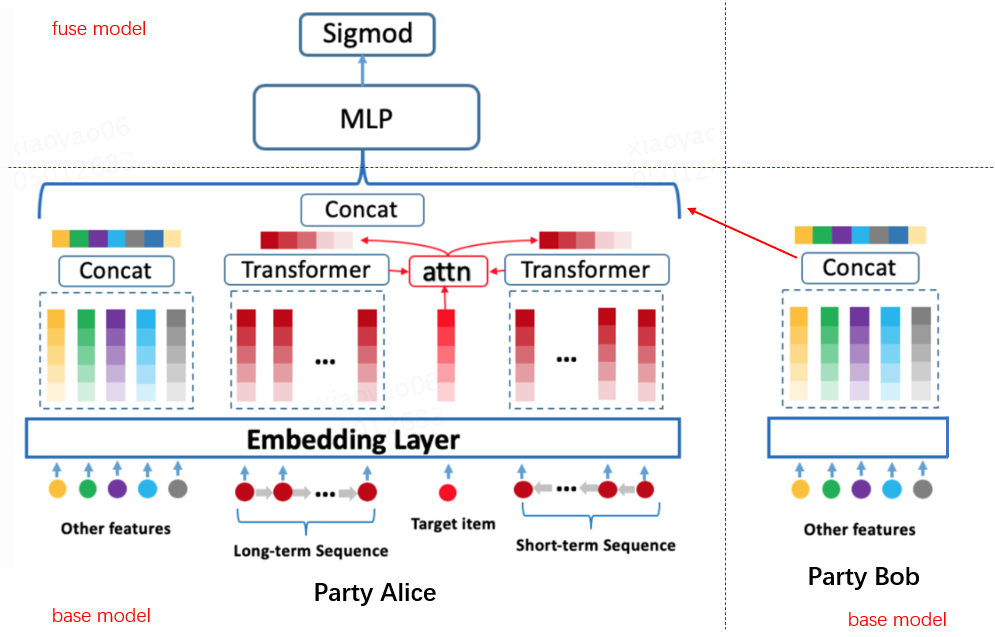
其中 Transformer Layer 使用一层 multi-head self-attention 结构,如图右侧所示。
Transformer layer 的输入是序列特征的 Embedding 和位置 Embedding 的加和。
隐语中的拆分 BST 模型#
隐语考虑两方拆分学习场景,两方各持有一些特征,包括序列特征和其他特,一方持有 label 。双方特征经过 base 模型处理后,将 base 模型的输出输入到 fuse 模型进行学习,根据对序列特征的处理不同分为拆分 BST 模型和拆分 BSTPlus 模型。
拆分 BST 模型#
其中序列特征通过 Transformer Layer 处理,其他特征通过普通的 Embedding 处理,序列特征和其他特征是可选的,模型结构如图所示。
拆分 BSTPlus 模型#
上述 BST 模型虽然能够有效捕捉序列信息,但对于同一用户不同商品的预估来说,序列信息都是相同的,并不能区分同一用户行为序列与不同商品的关联性,因此 BSTPlus 模型在 BST 基础上叠加 DIN 中的 attention 思想,对 target item 和 Transformer layer 的输出进行 attention pooling,通过计算 target item 对序列中 item 的注意力来挖掘用户行为序列与 target item 之间的关联信息,结构如下图。由于 target item 存在于 label 方,暂不支持无 label 方有序列特征。
隐语封装#
我们在隐语中提供了对于各种应用的封装。 关于 BST 的封装在 secretflow/ml/nn/applications/sl_bst_tf.py,提供了 BSTBase,BSTPlusBase 和 BSTFuse 几个类。 下面我们通过一个例子来看一下如何使用隐语封装的 BST 来进行训练。
环境设置#
[1]:
import secretflow as sf

# Check the version of your SecretFlow
print('The version of SecretFlow: {}'.format(sf.__version__))

# In case you have a running secretflow runtime already.
sf.shutdown()
sf.init(['alice', 'bob'], address="local", log_to_driver=False)
alice, bob = sf.PYU('alice'), sf.PYU('bob')
device_y = bob
The version of SecretFlow: 1.2.0.dev20231106
2023-11-09 06:23:21,777 INFO worker.py:1538 -- Started a local Ray instance.
数据集介绍#
这里将使用最经典的 MovieLens 数据集进行演示。 MovieLens 是一个开放式的推荐系统数据集,包含了电影评分和电影元数据信息。
下载并处理数据#
[2]:
import os
from pathlib import Path
import shutil

data_dir = './test_bst_data_tf'
dataset_download_dir = data_dir + '/data_download'
gen_data_path = data_dir + '/data_sl_bst'


def generate_data(plus=True):
    import numpy as np
    import pandas as pd

    from secretflow.utils.simulation.datasets import _DATASETS, get_dataset, unzip

    global dataset_download_dir
    if not Path(dataset_download_dir).is_dir():
        filepath = get_dataset(_DATASETS['ml-1m'])
        unzip(filepath, dataset_download_dir)

    dataset_dir = dataset_download_dir + '/ml-1m'
    # read data
    users = pd.read_csv(
        dataset_dir + "/users.dat",
        sep="::",
        names=["user_id", "gender", "age_group", "occupation", "zip_code"],
        engine='python',
    )

    ratings = pd.read_csv(
        dataset_dir + "/ratings.dat",
        sep="::",
        names=["user_id", "movie_id", "rating", "unix_timestamp"],
        engine='python',
    )

    movies = pd.read_csv(
        dataset_dir + "/movies.dat",
        sep="::",
        names=["movie_id", "title", "genres"],
        engine='python',
        encoding="ISO-8859-1",
    )

    users["user_id"] = users["user_id"].apply(lambda x: f"{x}")
    users["age_group"] = users["age_group"].apply(lambda x: f"{x}")
    users["occupation"] = users["occupation"].apply(lambda x: f"{x}")

    movies["movie_id"] = movies["movie_id"].apply(lambda x: f"{x}")
    movies["genres"] = movies["genres"].apply(lambda x: ','.join(x.split('|')))

    ratings["movie_id"] = ratings["movie_id"].apply(lambda x: f"{x}")
    ratings["user_id"] = ratings["user_id"].apply(lambda x: f"{x}")
    ratings["rating"] = ratings["rating"].apply(lambda x: float(x))

    # generate users' movie sequence
    ratings_group = ratings.sort_values(by=["unix_timestamp"]).groupby("user_id")

    ratings_data = pd.DataFrame(
        data={
            "user_id": list(ratings_group.groups.keys()),
            "movie_ids": list(ratings_group.movie_id.apply(list)),
            "ratings": list(ratings_group.rating.apply(list)),
            "timestamps": list(ratings_group.unix_timestamp.apply(list)),
        }
    )

    # split sequence
    if plus:
        sequence_length = 5
        step_size = 4
    else:
        sequence_length = 4
        step_size = 2

    def create_sequences(values, window_size, step_size):
        sequences = []
        start_index = 0
        while True:
            end_index = start_index + window_size
            seq = values[start_index:end_index]
            if len(seq) < window_size:
                seq.extend(['[PAD]'] * (window_size - len(seq)))
                sequences.append(seq)
                break
            sequences.append(seq)
            start_index += step_size
        return sequences

    ratings_data.movie_ids = ratings_data.movie_ids.apply(
        lambda ids: create_sequences(ids, sequence_length, step_size)
    )

    ratings_data.ratings = ratings_data.ratings.apply(
        lambda ids: create_sequences(ids, sequence_length, step_size)
    )
    del ratings_data["timestamps"]

    ratings_data_movies = ratings_data[["user_id", "movie_ids"]].explode(
        "movie_ids", ignore_index=True
    )
    ratings_data_rating = ratings_data[["ratings"]].explode(
        "ratings", ignore_index=True
    )
    ratings_data_transformed = pd.concat(
        [ratings_data_movies, ratings_data_rating], axis=1
    )
    ratings_data_transformed = ratings_data_transformed.join(
        users.set_index("user_id"), on="user_id"
    )
    ratings_data_transformed['movie_id'] = ratings_data_transformed.movie_ids.apply(
        lambda x: x[-1] if '[PAD]' not in x else x[x.index('[PAD]') - 1]
    )

    if plus:
        # last movie in sequence is target movie
        ratings_data_transformed.movie_ids = ratings_data_transformed.movie_ids.apply(
            lambda x: ",".join(x[:-1])
            if '[PAD]' not in x
            else ",".join(x[: x.index('[PAD]') - 1] + x[x.index('[PAD]') :])
        )
    else:
        ratings_data_transformed.movie_ids = ratings_data_transformed.movie_ids.apply(
            lambda x: ",".join(x)
        )

    ratings_data_transformed['label'] = ratings_data_transformed.ratings.apply(
        lambda x: x[-1] if '[PAD]' not in x else x[x.index('[PAD]') - 1]
    )

    ratings_data_transformed.ratings = ratings_data_transformed.ratings.apply(
        lambda x: ",".join([str(v) for v in x[:-1]])
    )
    ratings_data_transformed = ratings_data_transformed.join(
        movies.set_index("movie_id"), on="movie_id"
    )

    del (
        ratings_data_transformed["zip_code"],
        ratings_data_transformed["title"],
        ratings_data_transformed["genres"],
        ratings_data_transformed["ratings"],
    )

    ratings_data_transformed.rename(
        columns={"movie_ids": "sequence_movie_ids", "movie_id": "target_movie_id"},
        inplace=True,
    )
    random_selection = np.random.rand(len(ratings_data_transformed.index)) <= 0.85
    train_data = ratings_data_transformed[random_selection]
    test_data = ratings_data_transformed[~random_selection]

    # save data
    if os.path.exists(gen_data_path):
        shutil.rmtree(gen_data_path)
    os.mkdir(gen_data_path)
    os.mkdir(gen_data_path + '/vocabulary')

    train_data.to_csv(
        gen_data_path + "/train_data.csv", index=False, sep="|", encoding='utf-8'
    )
    test_data.to_csv(
        gen_data_path + "/test_data.csv", index=False, sep="|", encoding='utf-8'
    )

    train_data_alice = train_data[["gender", "age_group", "occupation"]]
    train_data_bob = train_data[
        [
            "user_id",
            "sequence_movie_ids",
            "target_movie_id",
            "label",
        ]
    ]

    test_data_alice = test_data[["gender", "age_group", "occupation"]]
    test_data_bob = test_data[
        [
            "user_id",
            "sequence_movie_ids",
            "target_movie_id",
            "label",
        ]
    ]

    train_data_alice.to_csv(
        gen_data_path + "/train_data_alice.csv", index=False, sep="|", encoding='utf-8'
    )
    train_data_bob.to_csv(
        gen_data_path + "/train_data_bob.csv", index=False, sep="|", encoding='utf-8'
    )

    test_data_alice.to_csv(
        gen_data_path + "/test_data_alice.csv", index=False, sep="|", encoding='utf-8'
    )
    test_data_bob.to_csv(
        gen_data_path + "/test_data_bob.csv", index=False, sep="|", encoding='utf-8'
    )

    with open(gen_data_path + '/vocabulary/user_id', 'w') as f:
        f.write('\n'.join(list(ratings_data_transformed.user_id.unique())))

    with open(gen_data_path + '/vocabulary/gender', 'w') as f:
        f.write('\n'.join(list(ratings_data_transformed.gender.unique())))

    with open(gen_data_path + '/vocabulary/age_group', 'w') as f:
        f.write('\n'.join(list(ratings_data_transformed.age_group.unique())))

    with open(gen_data_path + '/vocabulary/occupation', 'w') as f:
        f.write('\n'.join(list(ratings_data_transformed.occupation.unique())))

    with open(gen_data_path + '/vocabulary/item_id', 'w') as f:
        f.write('\n'.join(list(movies.movie_id.unique())))


generate_data()
[3]:
! head ./test_bst_data_tf/data_sl_bst/train_data_alice.csv
gender|age_group|occupation
F|1|10
F|1|10
F|1|10
F|1|10
F|1|10
F|1|10
F|1|10
F|1|10
F|1|10
[4]:
! head ./test_bst_data_tf/data_sl_bst/train_data_bob.csv
user_id|sequence_movie_ids|target_movie_id|label
1|3186,1721,1270,1022|2340|3.0
1|2340,1836,3408,1207|2804|5.0
1|2804,260,720,1193|919|4.0
1|2028,3105,938,1035|1962|4.0
1|1962,1028,2018,150|1097|4.0
1|1097,914,1287,2797|1246|4.0
1|1246,2762,661,2918|531|4.0
1|531,3114,2791,1029|2321|3.0
1|2321,1197,594,2398|1545|4.0
到这里,我们以及产出训练测试用的数据文件。
构造 dataset_builder 处理数据#
这里对特征进行 ID 化处理,rating > 3 作为正样本,否则作为负样本
[5]:
def create_dataset_builder_alice(
    batch_size=128,
    repeat_count=5,
):
    def dataset_builder(x):
        import pandas as pd
        import tensorflow as tf

        x = [dict(t) if isinstance(t, pd.DataFrame) else t for t in x]
        x = x[0] if len(x) == 1 else tuple(x)
        data_set = (
            tf.data.Dataset.from_tensor_slices(x).batch(batch_size).repeat(repeat_count)
        )

        return data_set

    return dataset_builder


def create_dataset_builder_bob(
    batch_size=128,
    repeat_count=5,
):
    def _parse_bob(row_sample, label):
        import tensorflow as tf

        y_t = label["label"]
        y = tf.expand_dims(
            tf.where(
                y_t > 3,
                tf.ones_like(y_t, dtype=tf.float32),
                tf.zeros_like(y_t, dtype=tf.float32),
            ),
            axis=1,
        )
        return row_sample, y

    def dataset_builder(x):
        import pandas as pd
        import tensorflow as tf

        x = [dict(t) if isinstance(t, pd.DataFrame) else t for t in x]
        x = x[0] if len(x) == 1 else tuple(x)
        data_set = (
            tf.data.Dataset.from_tensor_slices(x).batch(batch_size).repeat(repeat_count)
        )

        data_set = data_set.map(_parse_bob)

        return data_set

    return dataset_builder


batch_size = 128
epoch = 1
data_builder_dict = {
    alice: create_dataset_builder_alice(
        batch_size=batch_size,
        repeat_count=epoch,
    ),
    bob: create_dataset_builder_bob(
        batch_size=batch_size,
        repeat_count=epoch,
    ),
}
定义模型结构#
通过 plus 指定 base 模型结构 - plus=True: BSTBase - plus=False: BSTPlusBase
[6]:
from secretflow.ml.nn.applications.sl_bst_tf import BSTBase, BSTFuse, BSTPlusBase


def create_bstplus_base_model_alice():
    # Create model
    def create_model():
        import tensorflow as tf
        from tensorflow.keras import layers

        fea_list = ["gender", "age_group", "occupation"]
        fea_emb_size = {"gender": 8, "age_group": 8, "occupation": 8}
        fea_voc = {}
        for key in fea_list:
            with open(gen_data_path + '/vocabulary/' + key) as f:
                values = [line.strip() for line in f.readlines()]
                fea_voc[key] = values

        def preprocess():
            inputs = {}
            outputs = {}
            for key in fea_list:
                inputs[key] = tf.keras.Input(shape=(1,), dtype=tf.string)

                idx = layers.StringLookup(
                    vocabulary=fea_voc[key],
                    mask_token=None,
                    num_oov_indices=0,
                    name=f"{key}_index_lookup",
                )(inputs[key])

                outputs[key] = layers.Embedding(
                    input_dim=len(fea_voc[key]),
                    output_dim=fea_emb_size[key],
                    name=f"{key}_embedding",
                )(idx)

            return tf.keras.Model(inputs=inputs, outputs=outputs)

        preprocess_layer = preprocess()
        model = BSTPlusBase(
            preprocess_layer=preprocess_layer,
            dnn_units_size=[32],
        )
        model.compile(
            loss=tf.keras.losses.binary_crossentropy,
            optimizer=tf.keras.optimizers.Adam(),
            metrics=[
                tf.keras.metrics.AUC(),
                tf.keras.metrics.Precision(),
                tf.keras.metrics.Recall(),
            ],
        )
        return model  # need wrap

    return create_model


def create_bstplus_base_model_bob():
    # Create model
    def create_model():
        import tensorflow as tf
        from tensorflow.keras import layers

        fea_list = ["user_id"]
        fea_emb_size = {"user_id": 8}
        fea_voc = {}
        for key in fea_list:
            with open(gen_data_path + '/vocabulary/' + key) as f:
                values = [line.strip() for line in f.readlines()]
                fea_voc[key] = values

        with open(gen_data_path + '/vocabulary/item_id') as f:
            values = [line.strip() for line in f.readlines()]
            fea_voc["item"] = values

        seq_len = 4
        item_embedding_dims = 9

        def preprocess():
            inputs = {}
            outputs = {}
            for key in fea_list:
                inputs[key] = tf.keras.Input(shape=(1,), dtype=tf.string)

                idx = layers.StringLookup(
                    vocabulary=fea_voc[key],
                    mask_token=None,
                    num_oov_indices=0,
                    name=f"{key}_index_lookup",
                )(inputs[key])

                outputs[key] = layers.Embedding(
                    input_dim=len(fea_voc[key]),
                    output_dim=fea_emb_size[key],
                    name=f"{key}_embedding",
                )(idx)

            # sequence input
            inputs["sequence_movie_ids"] = tf.keras.Input(
                name="sequence_movie_ids",
                shape=(1,),
                dtype=tf.string,
            )

            inputs['target_movie_id'] = tf.keras.Input(
                name="target_movie_id",
                shape=(1,),
                dtype=tf.string,
            )

            item_lookup_layer = layers.StringLookup(
                vocabulary=fea_voc["item"],
                mask_token='[PAD]',  # note here!
                name="item_index_lookup",
            )

            seq_split = tf.strings.split(inputs["sequence_movie_ids"], ',').to_tensor(
                '[PAD]', shape=[None, 1, 4]
            )

            item_idx = item_lookup_layer(seq_split)
            outputs["sequence_idx"] = item_idx

            target_item_idx = item_lookup_layer(inputs['target_movie_id'])
            outputs['target_movie_id'] = target_item_idx

            return tf.keras.Model(inputs=inputs, outputs=outputs)

        preprocess_layer = preprocess()
        model = BSTPlusBase(
            preprocess_layer=preprocess_layer,
            dnn_units_size=[32],
            sequence_fea=["sequence_idx"],
            target_fea="target_movie_id",
            item_embedding_dims={"target_movie_id": item_embedding_dims},
            seq_len={"sequence_idx": seq_len},
            item_voc_size={"target_movie_id": len(fea_voc["item"])},
            num_head={"sequence_idx": 3},
            dropout_rate={"sequence_idx": 0.1},
        )

        model.compile(
            loss=tf.keras.losses.binary_crossentropy,
            optimizer=tf.keras.optimizers.Adam(),
            metrics=[
                tf.keras.metrics.AUC(),
                tf.keras.metrics.Precision(),
                tf.keras.metrics.Recall(),
            ],
        )
        return model  # need wrap

    return create_model


def create_base_model_alice():
    # Create model
    def create_model():
        import tensorflow as tf
        from tensorflow.keras import layers

        fea_list = ["gender", "age_group", "occupation"]
        fea_emb_size = {"gender": 8, "age_group": 8, "occupation": 8}
        fea_voc = {}
        for key in fea_list:
            with open(gen_data_path + '/vocabulary/' + key) as f:
                values = [line.strip() for line in f.readlines()]
                fea_voc[key] = values

        def preprocess():
            inputs = {}
            outputs = {}
            for key in fea_list:
                inputs[key] = tf.keras.Input(shape=(1,), dtype=tf.string)

                idx = layers.StringLookup(
                    vocabulary=fea_voc[key],
                    mask_token=None,
                    num_oov_indices=0,
                    name=f"{key}_index_lookup",
                )(inputs[key])

                outputs[key] = layers.Embedding(
                    input_dim=len(fea_voc[key]),
                    output_dim=fea_emb_size[key],
                    name=f"{key}_embedding",
                )(idx)

            return tf.keras.Model(inputs=inputs, outputs=outputs)

        preprocess_layer = preprocess()
        model = BSTBase(
            preprocess_layer=preprocess_layer,
            dnn_units_size=[32],
        )
        model.compile(
            loss=tf.keras.losses.binary_crossentropy,
            optimizer=tf.keras.optimizers.Adam(),
            metrics=[
                tf.keras.metrics.AUC(),
                tf.keras.metrics.Precision(),
                tf.keras.metrics.Recall(),
            ],
        )
        return model  # need wrap

    return create_model


def create_base_model_bob():
    # Create model
    def create_model():
        import tensorflow as tf
        from tensorflow.keras import layers

        fea_list = ["user_id"]
        fea_emb_size = {"user_id": 8}
        fea_voc = {}
        for key in fea_list:
            with open(gen_data_path + '/vocabulary/' + key) as f:
                values = [line.strip() for line in f.readlines()]
                fea_voc[key] = values

        with open(gen_data_path + '/vocabulary/item_id') as f:
            values = [line.strip() for line in f.readlines()]
            fea_voc["item"] = values

        seq_len = 4
        item_embedding_dims = 9

        def preprocess():
            inputs = {}
            outputs = {}
            for key in fea_list:
                inputs[key] = tf.keras.Input(shape=(1,), dtype=tf.string)

                idx = layers.StringLookup(
                    vocabulary=fea_voc[key],
                    mask_token=None,
                    num_oov_indices=0,
                    name=f"{key}_index_lookup",
                )(inputs[key])

                outputs[key] = layers.Embedding(
                    input_dim=len(fea_voc[key]),
                    output_dim=fea_emb_size[key],
                    name=f"{key}_embedding",
                )(idx)

            # sequence input
            inputs["sequence_movie_ids"] = tf.keras.Input(
                name="sequence_movie_ids",
                shape=(1,),
                dtype=tf.string,
            )

            seq_split = tf.strings.split(inputs["sequence_movie_ids"], ',').to_tensor(
                '[PAD]', shape=[None, 1, 4]
            )

            item_idx = layers.StringLookup(
                vocabulary=fea_voc["item"],
                mask_token='[PAD]',  # note here!
                name="item_index_lookup",
            )(seq_split)
            outputs["sequence_idx"] = item_idx

            return tf.keras.Model(inputs=inputs, outputs=outputs)

        preprocess_layer = preprocess()
        model = BSTBase(
            preprocess_layer=preprocess_layer,
            dnn_units_size=[32],
            sequence_fea=["sequence_idx"],
            item_embedding_dims={"sequence_idx": item_embedding_dims},
            seq_len={"sequence_idx": seq_len},
            item_voc_size={"sequence_idx": len(fea_voc["item"])},
            num_head={"sequence_idx": 2},
            dropout_rate={"sequence_idx": 0.5},
        )

        model.compile(
            loss=tf.keras.losses.binary_crossentropy,
            optimizer=tf.keras.optimizers.Adam(),
            metrics=[
                tf.keras.metrics.AUC(),
                tf.keras.metrics.Precision(),
                tf.keras.metrics.Recall(),
            ],
        )
        return model  # need wrap

    return create_model


def create_fuse_model():
    # Create model
    def create_model():
        import tensorflow as tf

        model = BSTFuse(dnn_units_size=[256, 128])
        model.compile(
            loss=tf.keras.losses.binary_crossentropy,
            optimizer=tf.keras.optimizers.Adam(),
            metrics=[
                tf.keras.metrics.AUC(),
                tf.keras.metrics.Precision(),
                tf.keras.metrics.Recall(),
            ],
        )
        return model

    return create_model


plus = True
if plus:
    model_base_alice = create_bstplus_base_model_alice()
    model_base_bob = create_bstplus_base_model_bob()
else:
    model_base_alice = create_base_model_alice()
    model_base_bob = create_base_model_bob()

base_model_dict = {
    alice: model_base_alice,
    bob: model_base_bob,
}
model_fuse = create_fuse_model()
定义 SL Model#
[7]:
from secretflow.ml.nn import SLModel

sl_model = SLModel(
    base_model_dict=base_model_dict,
    device_y=device_y,
    model_fuse=model_fuse,
    random_seed=0,
)
INFO:root:Create proxy actor <class 'secretflow.ml.nn.sl.backend.tensorflow.sl_base.PYUSLTFModel'> with party alice.
INFO:root:Create proxy actor <class 'secretflow.ml.nn.sl.backend.tensorflow.sl_base.PYUSLTFModel'> with party bob.
开始训练#
[8]:
from secretflow.data.vertical import read_csv


vdf = read_csv(
    {
        alice: gen_data_path + '/train_data_alice.csv',
        bob: gen_data_path + '/train_data_bob.csv',
    },
    delimiter='|',
)
label = vdf["label"]
data = vdf.drop(columns=["label"])

data["user_id"] = data["user_id"].astype("string")
data["age_group"] = data["age_group"].astype("string")
data["occupation"] = data["occupation"].astype("string")
data["target_movie_id"] = data["target_movie_id"].astype("string")

history = sl_model.fit(
    data,
    label,
    validation_data=(data, label),
    epochs=epoch,
    batch_size=batch_size,
    random_seed=0,
    dataset_builder=data_builder_dict,
)
print(history)
INFO:root:Create proxy actor <class 'secretflow.data.core.agent.PartitionAgent'> with party alice.
INFO:root:Create proxy actor <class 'secretflow.data.core.agent.PartitionAgent'> with party bob.
INFO:root:SL Train Params: {'x': VDataFrame(partitions={PYURuntime(alice): <secretflow.data.core.partition.Partition object at 0x7faafcce22b0>, PYURuntime(bob): <secretflow.data.core.partition.Partition object at 0x7faafccdf9d0>}, aligned=True), 'y': VDataFrame(partitions={PYURuntime(bob): <secretflow.data.core.partition.Partition object at 0x7faafccdfac0>}, aligned=True), 'batch_size': 128, 'epochs': 1, 'verbose': 1, 'callbacks': None, 'validation_data': (VDataFrame(partitions={PYURuntime(alice): <secretflow.data.core.partition.Partition object at 0x7faafcce22b0>, PYURuntime(bob): <secretflow.data.core.partition.Partition object at 0x7faafccdf9d0>}, aligned=True), VDataFrame(partitions={PYURuntime(bob): <secretflow.data.core.partition.Partition object at 0x7faafccdfac0>}, aligned=True)), 'shuffle': False, 'sample_weight': None, 'validation_freq': 1, 'dp_spent_step_freq': None, 'dataset_builder': {PYURuntime(alice): <function create_dataset_builder_alice.<locals>.dataset_builder at 0x7faafd07eaf0>, PYURuntime(bob): <function create_dataset_builder_bob.<locals>.dataset_builder at 0x7faafd07ec10>}, 'audit_log_params': {}, 'random_seed': 0, 'audit_log_dir': None, 'self': <secretflow.ml.nn.sl.sl_model.SLModel object at 0x7fabc4fa5fa0>}
100%|██████████| 1675/1675 [09:27<00:00,  2.95it/s, epoch: 1/1 -  train_loss:0.6462613940238953  train_auc_1:0.6504741907119751  train_precision_1:0.6380547881126404  train_recall_1:0.8145814538002014  val_loss:0.6162347197532654  val_auc_1:0.7021257281303406  val_precision_1:0.6727387309074402  val_recall_1:0.8101728558540344 ]
{'train_loss': [0.6462614], 'train_auc_1': [0.6504742], 'train_precision_1': [0.6380548], 'train_recall_1': [0.81458145], 'val_loss': [0.6162347], 'val_auc_1': [0.7021257], 'val_precision_1': [0.67273873], 'val_recall_1': [0.81017286]}
总结#
本文通过 MovieLens 数据集上的推荐任务来演示了如何通过隐语来训练拆分 BST 模型,您需要 1. 下载并处理数据集; 2. 构造 dataset_builder 处理数据;3. 定义模型结构,调用 BSTBase,BSTPlusBase和BSTFuse定义行模结构; 4. 使用 SLModel 进行训练,预测,评估即可。
您可以在自己的数据集上进行尝试,如有任何问题,可以在 github 上进行讨论。