SplitRec:在隐语中使用拆分 DeepFM 算法(Tensorflow 后端)#
以下代码仅作为示例,请勿在生产环境直接使用。
[1]:
%load_ext autoreload
%autoreload 2
隐语在垂直场景提供了SLModel来满足用户的垂直联邦需求,垂直场景中,各方通过特征互补,联合训练来达到训练出更好模型的目的。而在实际的应用场景中,推荐场景和垂直联邦方案非常契合。有很大的应用前景。 不同的数据持有方拥有不同的特征,彼此不愿意分享,但是特征之间是互补的,比如消费特征、金融特征和用户画像等。但是推荐算法往往并不是那么直接可以被应用到拆分学习中,比如FM算法需要特征交叉。 因此我们在隐语中提供了一个专项,通过对常用的推荐算法进行封装,来达到方便用户使用联邦学习进行推荐应用的目的。 本文下面将会介绍何在隐语中使用DeepFM算法
DeepFM拆分原理介绍#
DeepFM算法结合了FM和神经网络的长处,可以同时提升低维和高维特征,相比Wide&Deep模型还免去了特征工程的部分。
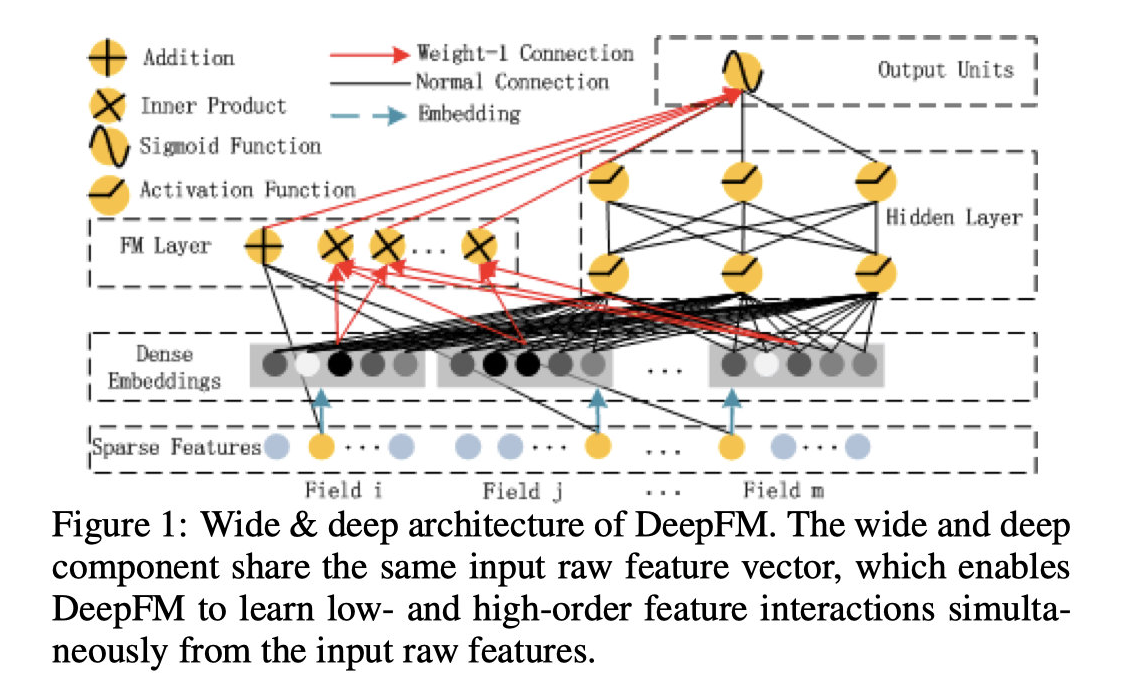
整体上来看。这个模型可以分成两个部分,分别是FM部分以及Deep部分。这两个部分的输入是一样的,并没有像Wide & Deep模型那样做区分。Deep的部分用来训练这些特征的高维的关联,而FM模型会通过隐藏向量V的形式来计算特征之间的二维交叉的信息。
隐语中的DeepFM#
拆分方案
DeepFM公式推导
进行数学化简
最终得到公式
DeepFM拆分版本#
从上面的公式推导可以看出,FM的计算中消去了$V_j$
所以问题就转成了只要每方计算好自己的 $sum_{i}^kViX$ 和 $sum_{i}^kV_i^2X^2$ 继续对这个公式进行化简得到
\[\hat{y}=w_0+\sum_{i=1}^nw_ix_i +\frac{1}{2}[\sum_{f=1}^k(\sum_{i=1}^nV_{i,f}x_i)^2 - \sum_{f=1}^k\sum_{i=1}^nV_{i,f}^2{x_i}^2]\]
从公式推导中可以看出,对于每一方参与者只需要在本地算出一阶$sum_{i=1}^aV_{i,f}x_i$和$sum_{i=1}^aV_{i,f}^2{x_i}^2$ 然后传输(1)和(2)两部分到fusenet即可完成无损的fm部分计算

隐语封装#
class DeepFMbase(tf.keras.Model):
    def __init__(
        self,
        dnn_units_size,
        dnn_activation="relu",
        preprocess_layer=None,
        fm_embedding_dim=16,
        **kwargs,
    ):
        """Split learning version of DeepFM
        Args:
            dnn_units_size: list,list of positive integer or empty list, the layer number and units in each layer of DNN
            dnn_activation: activation function of dnn part
            preprocess_layer: The preprocessed layer a keras model, output a dict of preprocessed data
            fm_embedding_dim: fm embedding dim, default to be 16
DeepFMFuse
class DeepFMfuse(tf.keras.Model):
    def __init__(self, dnn_units_size, dnn_activation="relu", **kwargs):
下面我们通过一个例子来看一下如果使用隐语封装的DeepFM来进行训练和预测
环境设置#
[2]:
import secretflow as sf

# Check the version of your SecretFlow
print('The version of SecretFlow: {}'.format(sf.__version__))

# In case you have a running secretflow runtime already.
sf.shutdown()
sf.init(['alice', 'bob', 'charlie'], address="local", log_to_driver=False)
alice, bob, charlie = sf.PYU('alice'), sf.PYU('bob'), sf.PYU('charlie')
The version of SecretFlow: 1.0.0a0
2023-07-25 11:26:15,683 INFO worker.py:1538 -- Started a local Ray instance.
数据集介绍#
DataBuilder相关的细节内容,请查看CustomDataLoaderOnSL
下载并处理数据#
数据拆分处理
[3]:
%%capture
%%!
wget https://secretflow-data.oss-accelerate.aliyuncs.com/datasets/movielens/ml-1m.zip
unzip ./ml-1m.zip
[4]:
# Read the data in dat format and convert it into a dictionary
def load_data(filename, columns):
    data = {}
    with open(filename, "r", encoding="unicode_escape") as f:
        for line in f:
            ls = line.strip("\n").split("::")
            data[ls[0]] = dict(zip(columns[1:], ls[1:]))
    return data
[5]:
fed_csv = {alice: "alice_ml1m.csv", bob: "bob_ml1m.csv"}
csv_writer_container = {alice: open(fed_csv[alice], "w"), bob: open(fed_csv[bob], "w")}
part_columns = {
    alice: ["UserID", "Gender", "Age", "Occupation", "Zip-code"],
    bob: ["MovieID", "Rating", "Title", "Genres", "Timestamp"],
}
[6]:
for device, writer in csv_writer_container.items():
    writer.write("ID," + ",".join(part_columns[device]) + "\n")
[7]:
f = open("ml-1m/ratings.dat", "r", encoding="unicode_escape")

users_data = load_data(
    "./ml-1m/users.dat",
    columns=["UserID", "Gender", "Age", "Occupation", "Zip-code"],
)
movies_data = load_data("./ml-1m/movies.dat", columns=["MovieID", "Title", "Genres"])
ratings_columns = ["UserID", "MovieID", "Rating", "Timestamp"]

rating_data = load_data("./ml-1m/ratings.dat", columns=ratings_columns)


def _parse_example(feature, columns, index):
    if "Title" in feature.keys():
        feature["Title"] = feature["Title"].replace(",", "_")
    if "Genres" in feature.keys():
        feature["Genres"] = feature["Genres"].replace("|", " ")
    values = []
    values.append(str(index))
    for c in columns:
        values.append(feature[c])
    return ",".join(values)


index = 0
num_sample = 1000
for line in f:
    ls = line.strip().split("::")
    rating = dict(zip(ratings_columns, ls))
    rating.update(users_data.get(ls[0]))
    rating.update(movies_data.get(ls[1]))
    for device, columns in part_columns.items():
        parse_f = _parse_example(rating, columns, index)
        csv_writer_container[device].write(parse_f + "\n")
    index += 1
    if num_sample > 0 and index >= num_sample:
        break
for w in csv_writer_container.values():
    w.close()
到此为止我们已经完成了数据的处理和拆分#
产出了
alice: alice_ml1m.csv
bob: bob_ml1m.csv
[8]:
! head alice_ml1m.csv
ID,UserID,Gender,Age,Occupation,Zip-code
0,1,F,1,10,48067
1,1,F,1,10,48067
2,1,F,1,10,48067
3,1,F,1,10,48067
4,1,F,1,10,48067
5,1,F,1,10,48067
6,1,F,1,10,48067
7,1,F,1,10,48067
8,1,F,1,10,48067
[9]:
! head bob_ml1m.csv
ID,MovieID,Rating,Title,Genres,Timestamp
0,1193,5,One Flew Over the Cuckoo's Nest (1975),Drama,978300760
1,661,3,James and the Giant Peach (1996),Animation Children's Musical,978302109
2,914,3,My Fair Lady (1964),Musical Romance,978301968
3,3408,4,Erin Brockovich (2000),Drama,978300275
4,2355,5,Bug's Life_ A (1998),Animation Children's Comedy,978824291
5,1197,3,Princess Bride_ The (1987),Action Adventure Comedy Romance,978302268
6,1287,5,Ben-Hur (1959),Action Adventure Drama,978302039
7,2804,5,Christmas Story_ A (1983),Comedy Drama,978300719
8,594,4,Snow White and the Seven Dwarfs (1937),Animation Children's Musical,978302268
构造data_builder_dict#
[10]:
# alice
def create_dataset_builder_alice(
    batch_size=128,
    repeat_count=5,
):
    def dataset_builder(x):
        import pandas as pd
        import tensorflow as tf

        x = [dict(t) if isinstance(t, pd.DataFrame) else t for t in x]
        x = x[0] if len(x) == 1 else tuple(x)
        data_set = (
            tf.data.Dataset.from_tensor_slices(x).batch(batch_size).repeat(repeat_count)
        )

        return data_set

    return dataset_builder


# bob
def create_dataset_builder_bob(
    batch_size=128,
    repeat_count=5,
):
    def _parse_bob(row_sample, label):
        import tensorflow as tf

        y_t = label["Rating"]
        y = tf.expand_dims(
            tf.where(
                y_t > 3,
                tf.ones_like(y_t, dtype=tf.float32),
                tf.zeros_like(y_t, dtype=tf.float32),
            ),
            axis=1,
        )
        return row_sample, y

    def dataset_builder(x):
        import pandas as pd
        import tensorflow as tf

        x = [dict(t) if isinstance(t, pd.DataFrame) else t for t in x]
        x = x[0] if len(x) == 1 else tuple(x)
        data_set = (
            tf.data.Dataset.from_tensor_slices(x).batch(batch_size).repeat(repeat_count)
        )

        data_set = data_set.map(_parse_bob)

        return data_set

    return dataset_builder


data_builder_dict = {
    alice: create_dataset_builder_alice(
        batch_size=128,
        repeat_count=5,
    ),
    bob: create_dataset_builder_bob(
        batch_size=128,
        repeat_count=5,
    ),
}
[ ]:
# Use the packaged DeepFMBase and DeepFMFuse to define the model
[11]:
from secretflow.ml.nn.applications.sl_deep_fm import DeepFMbase, DeepFMfuse
from secretflow.ml.nn import SLModel

NUM_USERS = 6040
NUM_MOVIES = 3952
GENDER_VOCAB = ["F", "M"]
AGE_VOCAB = [1, 18, 25, 35, 45, 50, 56]
OCCUPATION_VOCAB = [i for i in range(21)]
GENRES_VOCAB = [
    "Action",
    "Adventure",
    "Animation",
    "Children's",
    "Comedy",
    "Crime",
    "Documentary",
    "Drama",
    "Fantasy",
    "Film-Noir",
    "Horror",
    "Musical",
    "Mystery",
    "Romance",
    "Sci-Fi",
    "Thriller",
    "War",
    "Western",
]
2023-07-25 11:26:23.897995: W tensorflow/compiler/xla/stream_executor/platform/default/dso_loader.cc:64] Could not load dynamic library 'libcudart.so.11.0'; dlerror: libcudart.so.11.0: cannot open shared object file: No such file or directory; LD_LIBRARY_PATH: /opt/rh/devtoolset-11/root/usr/lib64:/opt/rh/devtoolset-11/root/usr/lib:/opt/rh/devtoolset-11/root/usr/lib64/dyninst:/opt/rh/devtoolset-11/root/usr/lib/dyninst
2023-07-25 11:26:24.839817: W tensorflow/compiler/xla/stream_executor/platform/default/dso_loader.cc:64] Could not load dynamic library 'libnvinfer.so.7'; dlerror: libnvinfer.so.7: cannot open shared object file: No such file or directory; LD_LIBRARY_PATH: /opt/rh/devtoolset-11/root/usr/lib64:/opt/rh/devtoolset-11/root/usr/lib:/opt/rh/devtoolset-11/root/usr/lib64/dyninst:/opt/rh/devtoolset-11/root/usr/lib/dyninst
2023-07-25 11:26:24.839928: W tensorflow/compiler/xla/stream_executor/platform/default/dso_loader.cc:64] Could not load dynamic library 'libnvinfer_plugin.so.7'; dlerror: libnvinfer_plugin.so.7: cannot open shared object file: No such file or directory; LD_LIBRARY_PATH: /opt/rh/devtoolset-11/root/usr/lib64:/opt/rh/devtoolset-11/root/usr/lib:/opt/rh/devtoolset-11/root/usr/lib64/dyninst:/opt/rh/devtoolset-11/root/usr/lib/dyninst
2023-07-25 11:26:24.839940: W tensorflow/compiler/tf2tensorrt/utils/py_utils.cc:38] TF-TRT Warning: Cannot dlopen some TensorRT libraries. If you would like to use Nvidia GPU with TensorRT, please make sure the missing libraries mentioned above are installed properly.
[12]:
# Define alice's basenet
def create_base_model_alice():
    # Create model
    def create_model():
        import tensorflow as tf

        def preprocess():
            inputs = {
                "UserID": tf.keras.Input(shape=(1,), dtype=tf.string),
                "Gender": tf.keras.Input(shape=(1,), dtype=tf.string),
                "Age": tf.keras.Input(shape=(1,), dtype=tf.int64),
                "Occupation": tf.keras.Input(shape=(1,), dtype=tf.int64),
            }
            user_id_output = tf.keras.layers.Hashing(
                num_bins=NUM_USERS, output_mode="one_hot"
            )
            user_gender_output = tf.keras.layers.StringLookup(
                vocabulary=GENDER_VOCAB, output_mode="one_hot"
            )

            user_age_out = tf.keras.layers.IntegerLookup(
                vocabulary=AGE_VOCAB, output_mode="one_hot"
            )
            user_occupation_out = tf.keras.layers.IntegerLookup(
                vocabulary=OCCUPATION_VOCAB, output_mode="one_hot"
            )

            outputs = {
                "UserID": user_id_output(inputs["UserID"]),
                "Gender": user_gender_output(inputs["Gender"]),
                "Age": user_age_out(inputs["Age"]),
                "Occupation": user_occupation_out(inputs["Occupation"]),
            }
            return tf.keras.Model(inputs=inputs, outputs=outputs)

        preprocess_layer = preprocess()
        model = DeepFMbase(
            dnn_units_size=[256, 32],
            preprocess_layer=preprocess_layer,
        )
        model.compile(
            loss=tf.keras.losses.binary_crossentropy,
            optimizer=tf.keras.optimizers.Adam(),
            metrics=[
                tf.keras.metrics.AUC(),
                tf.keras.metrics.Precision(),
                tf.keras.metrics.Recall(),
            ],
        )
        return model  # need wrap

    return create_model
[13]:
# Define bob's basenet
def create_base_model_bob():
    # Create model
    def create_model():
        import tensorflow as tf

        # define preprocess layer
        def preprocess():
            inputs = {
                "MovieID": tf.keras.Input(shape=(1,), dtype=tf.string),
                "Genres": tf.keras.Input(shape=(1,), dtype=tf.string),
            }

            movie_id_out = tf.keras.layers.Hashing(
                num_bins=NUM_MOVIES, output_mode="one_hot"
            )
            movie_genres_out = tf.keras.layers.TextVectorization(
                output_mode='multi_hot', split="whitespace", vocabulary=GENRES_VOCAB
            )
            outputs = {
                "MovieID": movie_id_out(inputs["MovieID"]),
                "Genres": movie_genres_out(inputs["Genres"]),
            }
            return tf.keras.Model(inputs=inputs, outputs=outputs)

        preprocess_layer = preprocess()

        model = DeepFMbase(
            dnn_units_size=[256, 32],
            preprocess_layer=preprocess_layer,
        )
        model.compile(
            loss=tf.keras.losses.binary_crossentropy,
            optimizer=tf.keras.optimizers.Adam(),
            metrics=[
                tf.keras.metrics.AUC(),
                tf.keras.metrics.Precision(),
                tf.keras.metrics.Recall(),
            ],
        )
        return model  # need wrap

    return create_model
定义Fusenet#
[14]:
def create_fuse_model():
    # Create model
    def create_model():
        import tensorflow as tf

        model = DeepFMfuse(dnn_units_size=[256, 256, 32])
        model.compile(
            loss=tf.keras.losses.binary_crossentropy,
            optimizer=tf.keras.optimizers.Adam(),
            metrics=[
                tf.keras.metrics.AUC(),
                tf.keras.metrics.Precision(),
                tf.keras.metrics.Recall(),
            ],
        )
        return model

    return create_model
[15]:
base_model_dict = {alice: create_base_model_alice(), bob: create_base_model_bob()}
model_fuse = create_fuse_model()
运行起来看看#
[16]:
from secretflow.data.vertical import read_csv as v_read_csv

vdf = v_read_csv(
    {alice: "alice_ml1m.csv", bob: "bob_ml1m.csv"}, keys="ID", drop_keys="ID"
)
label = vdf["Rating"]

data = vdf.drop(columns=["Rating", "Timestamp", "Title", "Zip-code"])
data["UserID"] = data["UserID"].astype("string")
data["MovieID"] = data["MovieID"].astype("string")

sl_model = SLModel(
    base_model_dict=base_model_dict,
    device_y=bob,
    model_fuse=model_fuse,
)
history = sl_model.fit(
    data,
    label,
    epochs=5,
    batch_size=128,
    random_seed=1234,
    dataset_builder=data_builder_dict,
)
INFO:root:Create proxy actor <class 'secretflow.ml.nn.sl.backend.tensorflow.sl_base.PYUSLTFModel'> with party alice.
INFO:root:Create proxy actor <class 'secretflow.ml.nn.sl.backend.tensorflow.sl_base.PYUSLTFModel'> with party bob.
INFO:root:SL Train Params: {'self': <secretflow.ml.nn.sl.sl_model.SLModel object at 0x7f993cf22760>, 'x': VDataFrame(partitions={PYURuntime(alice): Partition(data=<secretflow.device.device.pyu.PYUObject object at 0x7f993cf2e7f0>), PYURuntime(bob): Partition(data=<secretflow.device.device.pyu.PYUObject object at 0x7f993ced0250>)}, aligned=True), 'y': VDataFrame(partitions={PYURuntime(bob): Partition(data=<secretflow.device.device.pyu.PYUObject object at 0x7f993cf3d190>)}, aligned=True), 'batch_size': 128, 'epochs': 5, 'verbose': 1, 'callbacks': None, 'validation_data': None, 'shuffle': False, 'sample_weight': None, 'validation_freq': 1, 'dp_spent_step_freq': None, 'dataset_builder': {PYURuntime(alice): <function create_dataset_builder_alice.<locals>.dataset_builder at 0x7f9a2074f550>, PYURuntime(bob): <function create_dataset_builder_bob.<locals>.dataset_builder at 0x7f9a2074f940>}, 'audit_log_params': {}, 'random_seed': 1234, 'audit_log_dir': None}
  0%|          | 0/8 [00:00<?, ?it/s]2023-07-25 11:26:40.221001: E tensorflow/compiler/xla/stream_executor/cuda/cuda_driver.cc:267] failed call to cuInit: CUDA_ERROR_NO_DEVICE: no CUDA-capable device is detected
100%|██████████| 8/8 [00:08<00:00,  1.02s/it, epoch: 1/5 -  train_loss:0.7806562781333923  train_auc_1:0.4967503547668457  train_precision_1:0.628742516040802  train_recall_1:0.16746412217617035 ]
100%|██████████| 8/8 [00:00<00:00, 15.96it/s, epoch: 2/5 -  train_loss:0.6794981956481934  train_auc_1:0.5373517870903015  train_precision_1:0.6171548366546631  train_recall_1:0.9409888386726379 ]
100%|██████████| 8/8 [00:00<00:00, 14.90it/s, epoch: 3/5 -  train_loss:0.6782025694847107  train_auc_1:0.5984559655189514  train_precision_1:0.6269999742507935  train_recall_1:1.0 ]
100%|██████████| 8/8 [00:00<00:00, 15.26it/s, epoch: 4/5 -  train_loss:0.6483343243598938  train_auc_1:0.6253233551979065  train_precision_1:0.7081005573272705  train_recall_1:0.8086124658584595 ]
100%|██████████| 8/8 [00:00<00:00, 15.86it/s, epoch: 5/5 -  train_loss:0.6321477293968201  train_auc_1:0.6638531684875488  train_precision_1:0.6795511245727539  train_recall_1:0.8692185282707214 ]
到此为止,我们已经使用隐语提供的deepfm封装完成了movieLens数据集上的推荐任务训练。